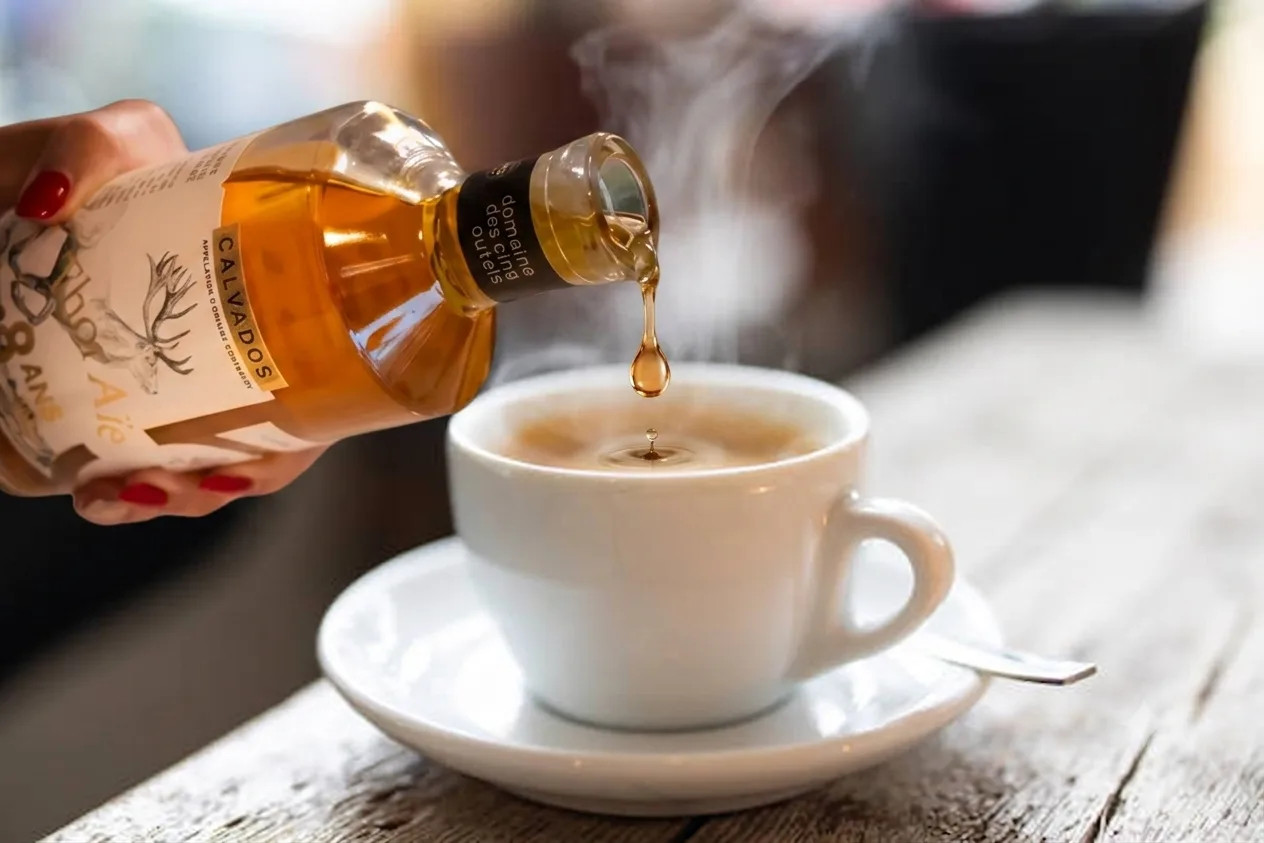
A strong coffee. A splash of calvados. Café calva is one of the simplest gestures in Norman gastronomy, and one of the most steeped in history. For nearly a century, it marked the mornings of farms, markets and café counters across France.
Born on 19th-century farms
Coffee became widespread in France over the course of the 19th century. In the Norman countryside, it met an eau-de-vie that almost every farm produced at the time: calvados, distilled from the cider of the press. The two quickly became a morning ritual. Farmhands and day labourers drank it before working the fields, to warm up and get the heart into the job.
The gesture then left the farms. It followed the rural exodus into the market towns, then into the cafés of Paris. Market day, cattle fair, the return from a fishing trip: café calva accompanied every kind of morning gathering Normandy had to offer.
Goutte, rincette, canard: a family of gestures
Café calva isn’t a fixed recipe. It’s a family of rituals, each with its own name.
The goutte: a splash of calvados poured straight into the coffee, to “correct” it. This is the café arrosé of the counters. The rincette: calvados poured into the empty cup, still warm from the coffee, then drunk in one go. Some carry on with the sur-rincette, but there, the domaine declines all responsibility. The canard: a sugar cube dipped in calvados, crunched alongside the coffee.
The golden age of the counters, 1880 to 1970
From the 1880s to the 1970s, café calva became an institution of the French zinc bar. Georges Simenon made it a social marker in the Inspector Maigret novels, who orders it in the working-class bistros of Paris. Erich Maria Remarque also wrote it into his fiction. In some working-class neighbourhoods, until the late 1970s, coffee served at the counter came arrosé by default, unless the customer said otherwise.
Then came the decline. Public health campaigns, the disappearance of manual trades, new working rhythms: through the 1980s, café calva retreated everywhere.
The comeback, through the neo-bistros
In recent years, café calva has been coming back. Cocktail bars and Parisian neo-bistros are putting it back on the menu; some twenty addresses in the capital now offer it. The logic has changed: it’s no longer about a morning pick-me-up, but about the pairing between a specialty coffee and a terroir eau-de-vie. Café calva now sits alongside Irish coffee in the family of coffee-and-spirit pairings.
Making it at home
You need very little. A strong coffee, freshly ground, not over-roasted. Two centilitres of calvados. And a choice of school: in the cup or on the side (see the FAQ below).
The choice of calvados matters more. The coffee’s bitterness crushes the fine notes of an old calvados. What it needs is fruit, liveliness, a clean attack: the profile of a young calvados. That’s exactly what our Le Songe offers, our 4-year-old: fresh apple, white flowers, a clean finish. The coffee brings out its fruit instead of smothering it.
Not to be confused with the trou normand
Café calva closes the meal. The trou normand, on the other hand, comes right in the middle: a glass of calvados between two courses, to mark a pause and revive the appetite. Two different rituals, often confused. We tell the story of the second, from Flaubert to apple sorbet, in our article on the trou normand.